Overview of Unix Filesystems
Key Question
How can we design filesystems to store and manipulate files on disk, and how can we interact with the filesystem in our programs?
Unix and C libraries for file manipulation:
stat,struct stat,open,close,read,write,readdir,struct dirent, file descriptors, regular files, directories, soft and hard links, programmatic manipulation of them, implementation ofls,cp,cat, etc.Naming, abstraction and layering concepts in systems as a means for managing complexity, blocks,
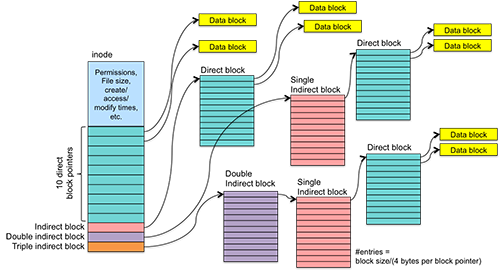
inodes,inodepointer structure,inodeas abstraction over blocks, direct blocks, indirect blocks, doubly indirect blocks, design and implementation of a file system.Additional systems examples that rely on naming, abstraction, modularity, and layering, including DNS, TCP/IP, network packets, databases, HTTP, REST, descriptors and
pids.Building modular systems with simultaneous goals of simplicity of implementation, fault tolerance, and flexibility of interactions.
Lectures
-
Learning Goals:
Learn about the differences in how data is stored in memory vs. on disk
Understand the design of the Unix v6 filesystem in how it represents files
Learn how to use indirect blocks to support even larger files
Understand the design of the Unix v6 filesystem in how it represents directories
Practice with the full process of going from file path to file data
Understand the tradeoffs and limitations in filesystem design
Readings:
S & K Chapter 2
-
Learning Goals:
Learn about the
open,close,readandwritefunctions that let us interact with filesGet familiar writing programs that read, write and create files
Learn what the operating system manages for us so that we can interact with files
Understand the use and versatility of file descriptors
Learn how file descriptors are used by the operating system to manage open files
Learn how system calls are made while preserving privacy and security
Become familiar with how to write a program that spawns another program
Readings:
Bryant & O’Hallaron, Chapters 10 and 8.
Labs
Lab 01: File Systems and System Calls
Assignments
Assignment 1: Six Degrees of Kevin Bacon
Assignment 2: Reading Unix V6 Filesystems